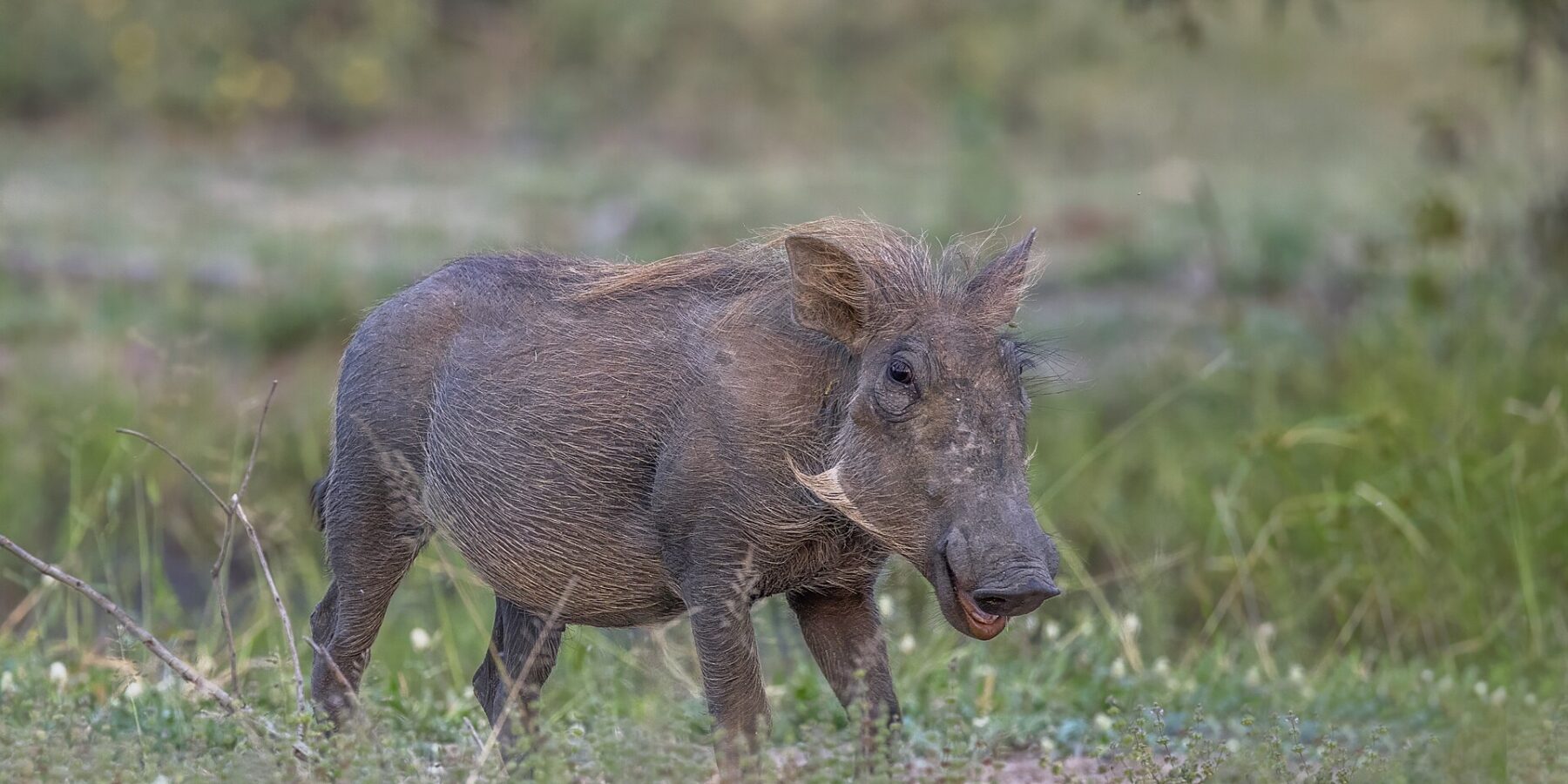
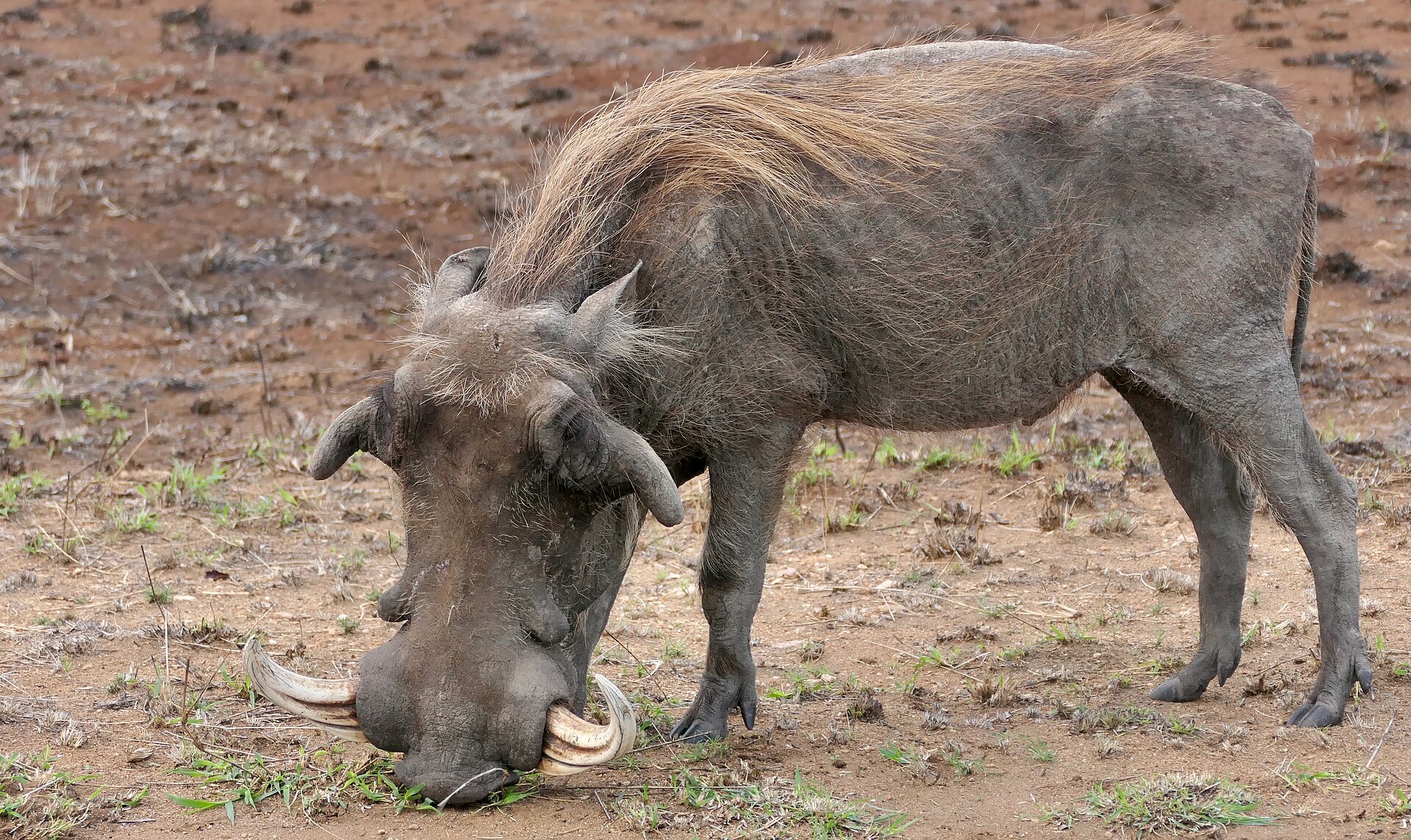
Kneeling in the grass, the warthog grazes beside the track, then bolts with its tail straight up like an antenna when the vehicle gets too close. This four-tusked wild pig lives in every park in South Africa, active in broad daylight, often in family groups, and it goes back into its burrow at nightfall.
Where to see the common warthog on safari?
 South AfricaNational park
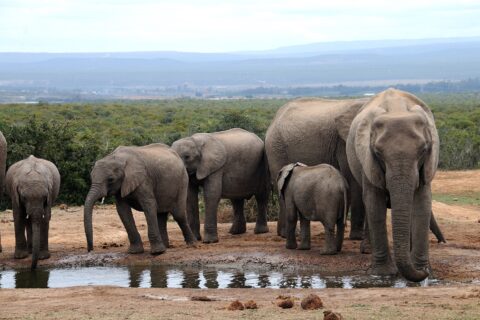
Addo Elephant National Park
Eastern CapePeak season all year round: everywhere, kneeling on the grass
 South AfricaGame reserve
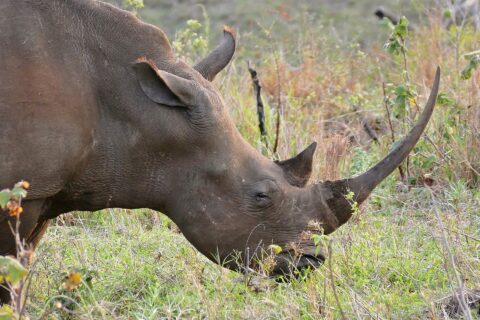
Hluhluwe-iMfolozi Park
KwaZulu-NatalPeak season all year round: grasslands and roadsides
 South AfricaNational park
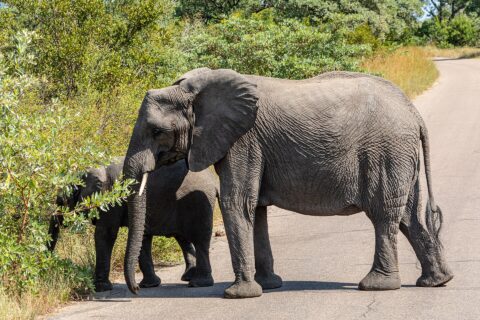
Kruger National Park
Northeastern South AfricaPeak season all year round: by the roadside, kneeling in the grass
 South AfricaGame reserve
Madikwe Game Reserve
Northwestern South AfricaPeak season all year round: lodge lawns and the edges of tracks
 South AfricaNational park
Pilanesberg National Park
Northwestern South AfricaPeak season all year round: grassy clearings and the edges of tracks
 South AfricaPrivate reserve
Sabi Sand Game Reserve
Northeastern South AfricaPeak season all year round: clearings and lodge lawns
How do you identify a warthog?
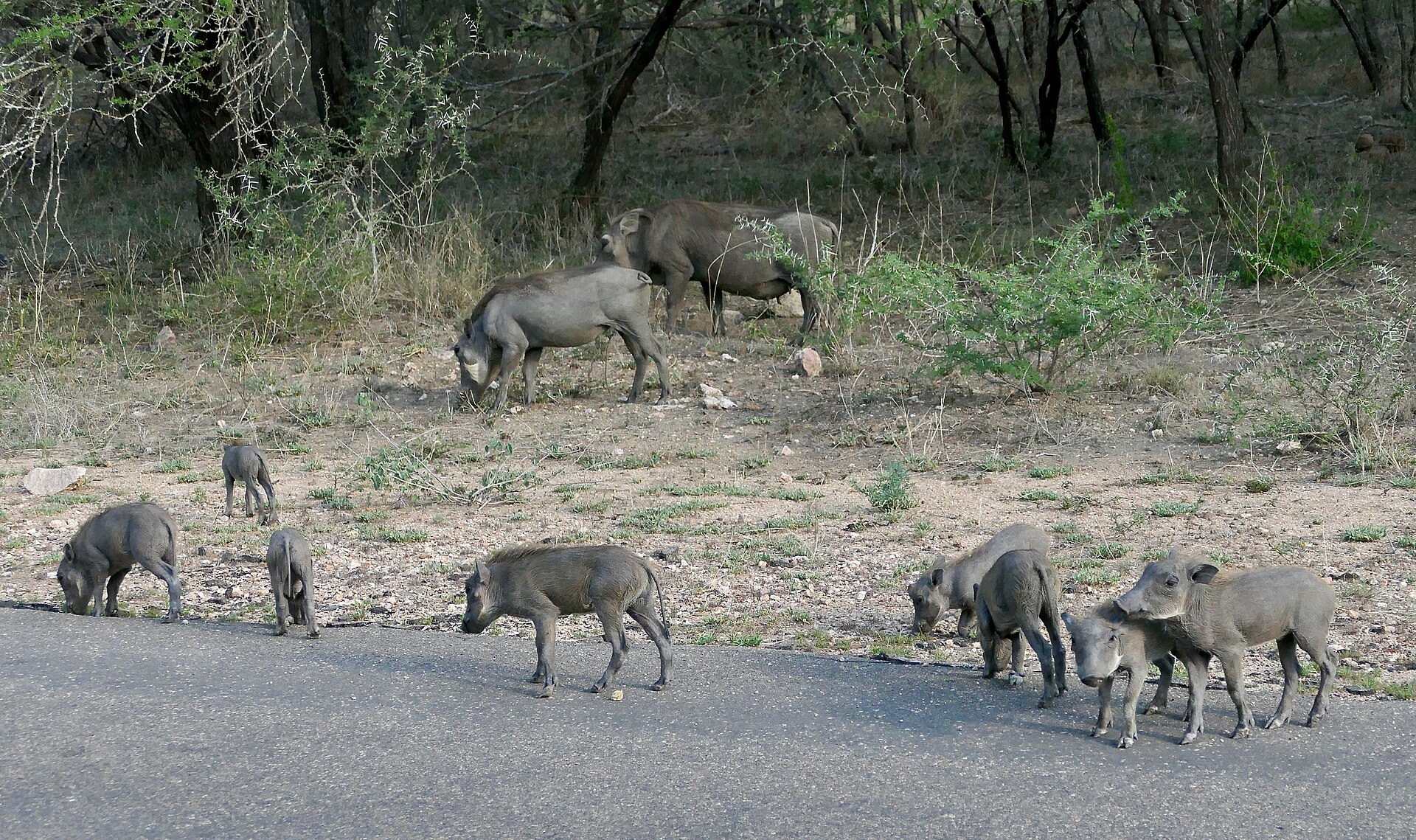
The warthog is a gray, almost hairless wild pig, 63 to 85 cm at the shoulder and 0.9 to 1.5 m long, weighing 60 to 150 kg for a male and 45 to 75 kg for a female. Its broad head carries two pairs of upcurved tusks, the upper ones up to 25 cm and the lower ones short and sharp, and two pairs of fleshy bumps, the warts, which are bigger on the male. A mane of long, stiff hair runs along the back, and the thin, tufted tail shoots up like an antenna as soon as it trots. No other animal in South Africa's parks looks like it.
Common warthog in pictures
How do warthogs live?
The warthog is the only wild pig that lives on the open savanna and is active by day. It grazes short grass on its knees, front legs folded under it, and digs up roots, bulbs and tubers with its snout and tusks, especially in the dry season. It also eats fruit, mushrooms and insects. Females and their young form family groups, and adult males live alone. At night, the family sleeps in an enlarged aardvark burrow, which it backs into, tusks facing the entrance, ready to charge at any intruder. It runs at up to 48 km/h, and it is common prey for lions, leopards, cheetahs, wild dogs, hyenas and crocodiles.
Where and when can you see warthogs on safari?
You will see them in every park in South Africa, with no effort at all. Kruger is full of them, on short-grass lawns and along the paved roads, and camps such as Skukuza or Addo have warthogs grazing between the bungalows. In Addo you meet them on the roads across the plains, in Sabi Sand on the lodge lawns, and in Hluhluwe-iMfolozi near the waterholes. They come out at sunrise, wallow in mud in the heat of the day and go back to the burrow before dark, so night drives almost never show them.
Are warthogs endangered?
The IUCN lists the common warthog as Least Concern. It is still abundant across sub-Saharan Africa, with about 250,000 animals in southern Africa in the late 1990s, and its population is doing well in South Africa's parks. The threats are local: hunting for meat outside protected areas, drought, which deprives it of grass and water, and African swine fever, which it carries without falling ill.
Our tip
You won't have to look for it, it comes to you: warthogs graze the lawns of the camps in Kruger and Addo and the roadsides. For a photo, wait until it drops to its knees to graze, its oddest pose, and keep your distance in camp, where an annoyed male can charge.