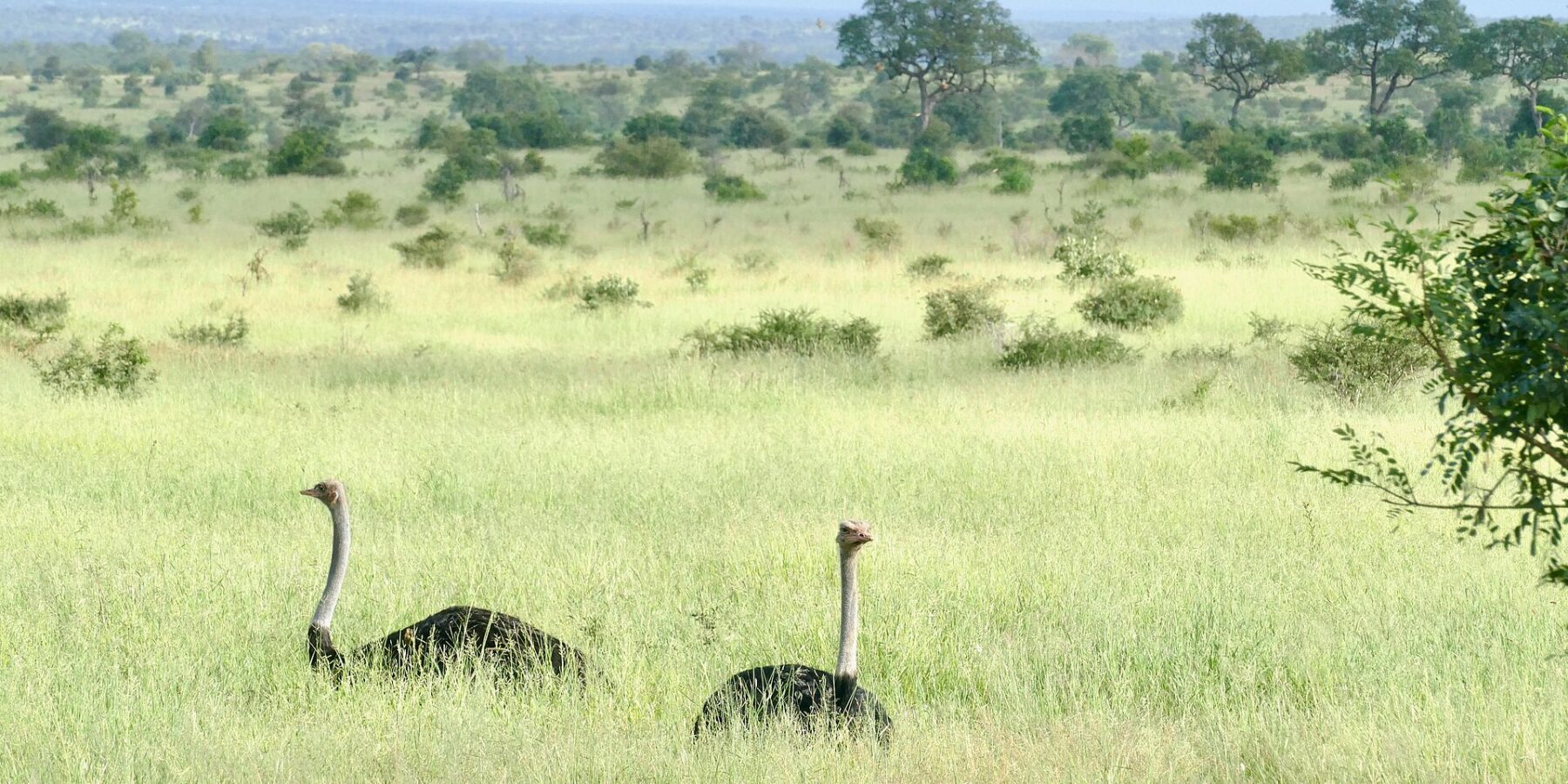
Standing over two meters tall, the ostrich rises above the savanna bushes and stands out from far away, the male black and white, the female gray-brown. You find it on the open plains of Kruger, around Satara, and in Addo, often in pairs or small groups, and sometimes running flat out at 70 km/h.
Where to see the ostrich on safari?
 South Africa
How do you identify an ostrich?
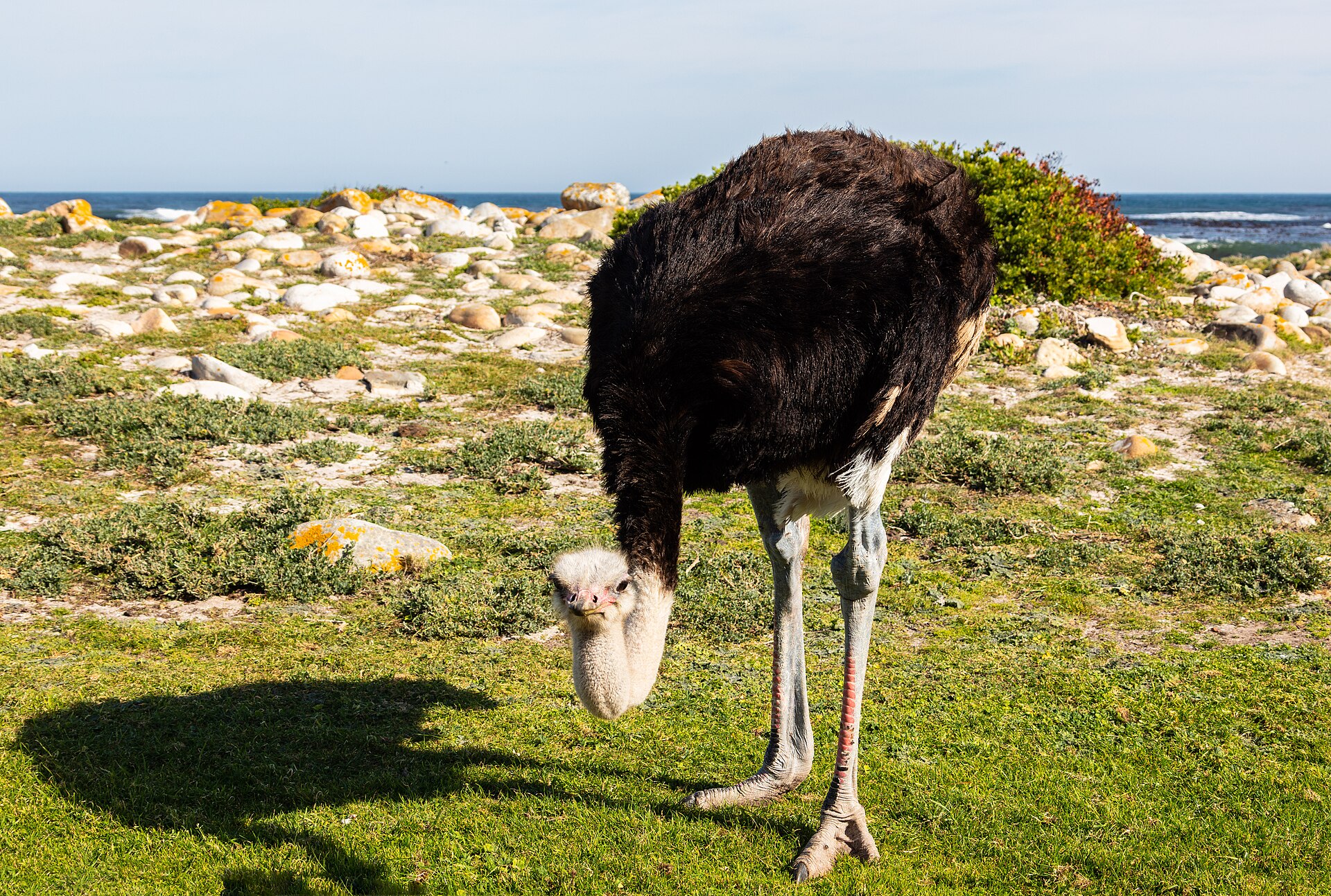
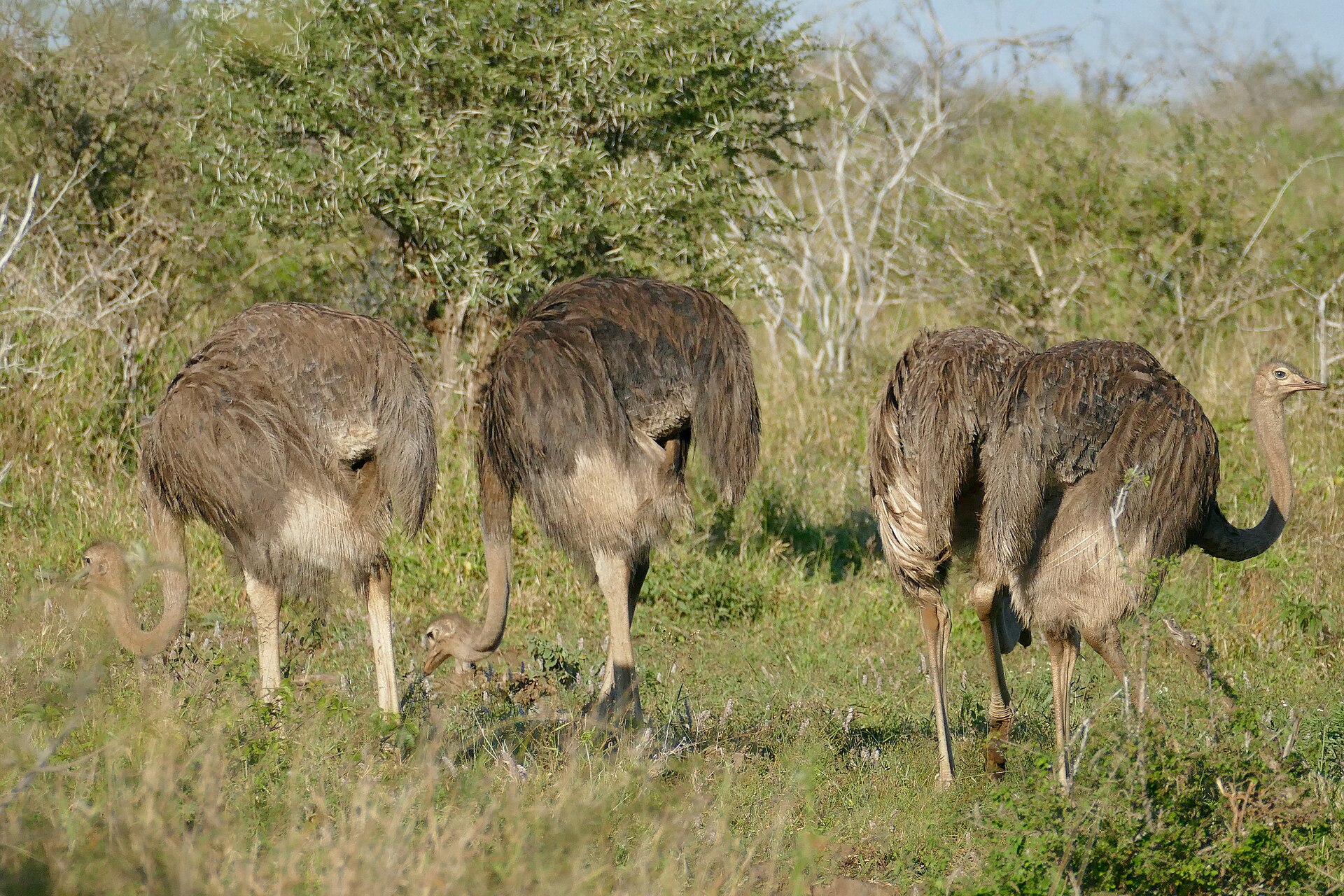
You can't mistake it: it is the largest living bird, 2.1 to 2.75 m tall and 100 to 130 kg for a male, 1.75 to 1.9 m for a female. The male has black plumage with white wing and tail feathers, while females and young birds are gray-brown. The long neck and the thighs are bare, pink or blue-gray depending on the subspecies, and the South African ostrich has a gray neck. Its eyes, 5 cm across, are the largest of any land animal. Each foot has only two toes, one of them large and clawed, an adaptation to running that you can see in its tracks.
Ostrich in pictures
How does the ostrich live?
The ostrich can't fly, but it can run: 55 km/h at cruising speed, over 70 km/h at top speed, with strides of several meters, and a kick strong enough to seriously injure a lion. It lives in nomadic groups of 5 to 50 birds in open savanna and semi-desert, often mixed in with zebras and antelopes, which it warns of danger thanks to its eyesight. It eats plants, seeds and insects, and swallows pebbles to grind it all up. In nesting season, a male scrapes out a hollow where several females lay 15 to 60 eggs of 1.4 kg each. The male sits on them at night and the dominant female by day, for 35 to 45 days.
Where and when can you see ostriches on safari?
The ostrich likes open plains with short grass. In Kruger, look for it in the center of the park, around Satara and on the Orpen road, and on the southeastern plains near Lower Sabie, where it grazes with zebras and wildebeest. Addo has them in its open areas, and you will also see them along the roads of the Eastern Cape, often on farms that breed them. It is active all day and can be spotted from very far away, a head on a long neck above the grass. The chicks, gray and striped, follow the adults in small bands.
Is the ostrich endangered?
The IUCN lists the common ostrich as Least Concern. The species remains widespread in the savannas and semi-deserts of the continent, and farming, once for feathers and today for meat and leather, has multiplied the number of domestic birds in South Africa, above all around Oudtshoorn. In South African parks, wild ostriches are doing well, and droughts, which reduce their egg-laying, remain their main problem.
Our tip
Look for it on short-grass plains, where its silhouette shows from far away, and check what is around it: zebras and antelopes often graze near ostriches, which are the first to raise the alarm thanks to their large eyes. In nesting season, a male that spreads its wings and lowers its head is getting ready to charge, and you need to move away.